


How Truck-Mounted Cranes Improve Efficiency in Construction and Transport
Views: 0 Author: Site Editor Publish Time: 2025-07-31 Origin: Site


Construction and transport projects require materials to be moved quickly and safely. Traditional operations may need one truck to deliver cargo and a separate crane to unload it, increasing waiting time, labor requirements, and equipment costs.
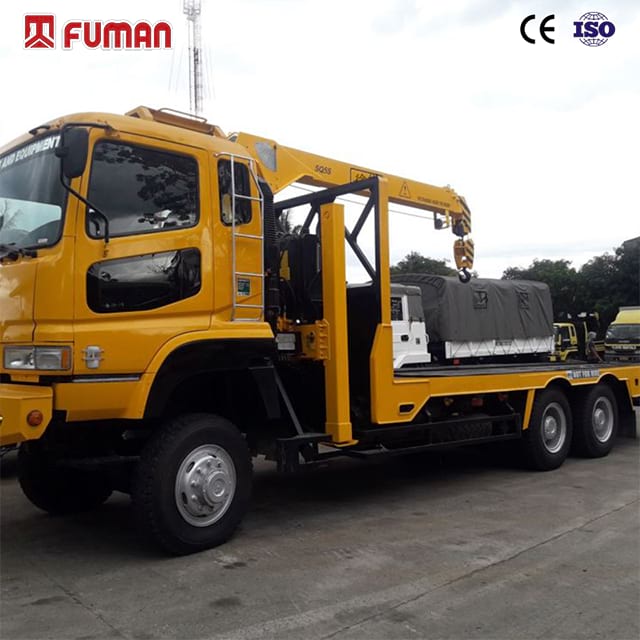
Truck-mounted cranes combine transportation and lifting in one system. Installed on a compatible commercial vehicle, they allow the truck to carry, load, unload, and position materials at the destination.
Xuzhou Fuman Special Vehicles Co., Ltd. manufactures telescopic-boom and knuckle-boom truck-mounted cranes for construction, logistics, utilities, forestry, and industrial material handling. FUMAN also provides grabs, hydraulic systems, accessories, and customized lifting solutions.
How Truck-Mounted Cranes Save Time
A truck-mounted crane can load materials at the point of origin and unload them at the destination. This reduces dependence on fixed lifting equipment or another crane vehicle.
| Traditional arrangement | Truck-mounted crane |
|---|---|
| Separate truck and crane | Transport and lifting combined |
| More equipment coordination | Simpler work scheduling |
| Possible unloading delays | Immediate lifting capability |
| Additional mobilization costs | Fewer machines for suitable jobs |
| Dependence on site equipment | More independent operation |
Common loads include building materials, pipes, machinery, pallets, utility equipment, and timber. By reducing waiting and repeated handling, one vehicle may complete more assignments during the working day.
Improving Equipment Utilization
A standard truck mainly transports cargo, while a dedicated crane performs lifting. A truck-mounted crane combines both functions where the load and working conditions are suitable.
This can improve equipment utilization by:
Reducing the number of machines sent to smaller jobs
Allowing independent loading and unloading
Limiting idle time at delivery locations
Supporting several work sites on one route
Responding quickly to unplanned handling tasks
Truck-mounted cranes do not replace large mobile cranes in every application. Heavy lifts, long working radii, and specialized installation work may still require dedicated lifting equipment.
Telescopic Booms for Direct Reach
A telescopic-boom crane uses straight sections that extend outward. Its direct boom geometry provides good vertical reach and straightforward hook lifting.
FUMAN telescopic-boom truck-mounted cranes can support tasks such as:
Lifting construction materials
Placing industrial equipment
Installing utility components
Unloading cargo in open areas
Reaching elevated work positions
The adjustable boom allows operators to reach beyond barriers or place materials at different heights. This can reduce manual handling and repeated vehicle repositioning.
Knuckle Booms for Flexible Positioning
A knuckle-boom crane uses articulated sections that fold into a compact transport position. Its multiple joints allow the boom to work around some obstacles and position loads close to the truck.
FUMAN knuckle-boom truck-mounted cranes are suitable for restricted construction sites, busy logistics yards, forestry work, and applications requiring hydraulic attachments.
| Boom design | Efficiency advantage | Suitable work |
|---|---|---|
| Telescopic boom | Direct extension and good vertical reach | Construction and elevated placement |
| Knuckle boom | Compact folding and flexible articulation | Logistics and restricted sites |
| Grab-equipped boom | Faster handling of specific materials | Forestry and recycling |
The appropriate design depends on the task. Telescopic booms are effective for direct lifting, while knuckle booms provide greater flexibility when space is limited.
Improving Construction Productivity
Construction sites often have limited space and changing material requirements. Truck-mounted cranes allow materials to be delivered closer to the required location and lifted directly from the cargo body.
Typical applications include:
Unloading steel, pipes, and panels
Positioning prefabricated components
Moving tools and small machinery
Handling formwork
Supporting maintenance work
Installing utility equipment
Direct placement reduces repeated material handling, which can shorten work cycles and reduce the risk of product damage.
All operations must remain within the crane’s load chart. Efficiency should never be achieved by exceeding rated capacity.
Increasing Transport Efficiency
Vehicle turnaround time is important in logistics. If a truck must wait for lifting equipment, one delayed delivery may affect the entire route.
A truck-mounted crane can unload independently at suitable sites, including remote projects, small construction locations, industrial yards, and areas without fixed lifting equipment.
Potential advantages include:
More predictable delivery schedules
Shorter unloading delays
Easier delivery to several locations
Reduced dependence on customer equipment
Greater control over load placement
Actual efficiency depends on site access, stabilizer space, ground conditions, working radius, and operator experience.
Attachments Expand Functionality
FUMAN cranes can be configured with different attachments when the crane structure and hydraulic system are compatible. Options may include:
Lifting hooks
Timber grabs
Material grabs
Brick grabs
Forks
Augers
Lifting baskets
A timber grab can improve forestry loading, while a material grab can accelerate handling in industrial or recycling yards. Using different attachments allows one crane to support more tasks.
Attachment weight reduces the available lifting capacity. Hydraulic attachments also require suitable flow, pressure, controls, and connections.
Personnel baskets may only be used when the complete crane system is specifically designed, configured and approved for lifting people.
Hydraulic Systems Affect Cycle Time
The hydraulic system controls boom lifting, extension, folding, and slewing. Correct hydraulic flow and pressure allow the crane to operate smoothly and efficiently.
Insufficient flow may slow the working cycle, while unsuitable pressure can reduce performance or damage components. The power source, hydraulic flow, pressure, oil tank, filtration, and cooling must match the selected FUMAN crane.
Smooth movement also improves load positioning and reduces repeated adjustments.
Stabilizers Support Efficient Setup
Stabilizers transfer lifting forces to the ground and help maintain stability. Before operating, the crew should confirm:
Sufficient deployment space
Firm and reasonably level ground
Suitable stabilizer pads
Clearance from excavations and underground voids
Correct setup for the planned lift
Fast setup is beneficial, but stabilizers must be deployed correctly. Poor ground support can cause instability even when the load is within the rated capacity.
FUMAN Heavy-Duty Crane
For demanding construction and industrial applications, the FUMAN 20 Ton Truck-Mounted Knuckle-Boom Crane, model F460KC-05, offers a maximum rated lifting capacity of 20,000 kg.
| Specification | Published value |
|---|---|
| Maximum lifting capacity | 20,000 kg |
| Maximum lifting moment | 15 ton·m |
| Recommended power | 37 kW |
| Hydraulic flow | 60 L/min |
| Hydraulic pressure | 28 MPa |
| Installation space | 1,350 mm |
| Slewing angle | Continuous 360° |

Actual lifting performance depends on the working radius, boom position, attachment, stabilizer setup, load chart, and final installation.
Choosing an Efficient Configuration
The largest crane is not always the most efficient. An oversized unit increases equipment weight, installation requirements, and cost while reducing the vehicle’s remaining cargo payload.
Before selecting a model, determine:
Maximum and typical load weights
Required working radius
Required lifting height
Preferred boom design
Available installation space
Hydraulic flow and pressure
Required attachments
Daily working frequency
Site and ground conditions
FUMAN can customize boom configurations, controls, hydraulic systems, installation dimensions, and compatible attachments according to the application.
Maintenance Protects Productivity
Unexpected downtime reduces efficiency. Regular inspection should cover hydraulic oil, filters, hoses, cylinders, boom joints, stabilizers, slewing parts, mounting bolts, attachments, and safety devices.
Operators should follow the maintenance schedule and inspect the crane before use. Early detection of leaks, wear, or loose components helps prevent longer interruptions.
Frequently Asked Questions
How does a truck-mounted crane save time?
It allows one vehicle to transport and unload cargo, reducing dependence on separate lifting equipment.
Which boom is more efficient?
Telescopic booms provide direct reach, while knuckle booms offer compact folding and flexible positioning. The application determines the better option.
Can one crane perform different tasks?
Yes. Compatible attachments can expand its functions, but their weight and hydraulic requirements must be considered.
Can a crane lift its maximum load at full reach?
Usually not. Capacity decreases as the working radius increases. Always check the official load chart.
Does FUMAN offer customized equipment?
FUMAN provides customization for boom configurations, hydraulic systems, controls, installation dimensions, and attachments.
Conclusion
Truck-mounted cranes improve construction and transport efficiency by combining cargo delivery with on-site lifting. They can reduce equipment coordination, shorten unloading time, improve load placement, and support work at multiple locations.
FUMAN telescopic-boom cranes provide direct reach for construction and elevated lifting, while its knuckle-boom cranes offer compact folding and flexible movement for logistics, forestry, and restricted sites.
Matching the crane’s capacity, working radius, boom type, hydraulic system, and attachments to the actual task allows operators to improve productivity without adding unnecessary equipment weight or cost.


