


The Benefits of Using A Boom Crane
Views: 0 Author: Site Editor Publish Time: 2025-11-04 Origin: Site


Boom cranes are revolutionizing industries with their impressive lifting capabilities. From construction to shipping, these machines are indispensable. But what makes them so essential? In this post, you'll learn about marine cranes boom and timber cranes boom, and how they enhance efficiency across various sectors. We'll explore their versatility, safety features, and cost-effectiveness in detail.
Heavy Lifting Capability of Boom Cranes
Types of Boom Cranes and Their Load Capacities
Boom cranes come in several types, each designed for specific lifting needs. Among the most common are:
● Telescopic Boom Cranes: These feature extendable sections, allowing for adjustable reach. They typically handle loads from 10 to over 100 tons, making them ideal for construction sites needing variable reach and capacity.
● Lattice Boom Cranes: Recognized for their strength and stability, these cranes are often used in large-scale infrastructure projects. They can lift loads exceeding 400 tons, suitable for heavy steel structures or large cargo.
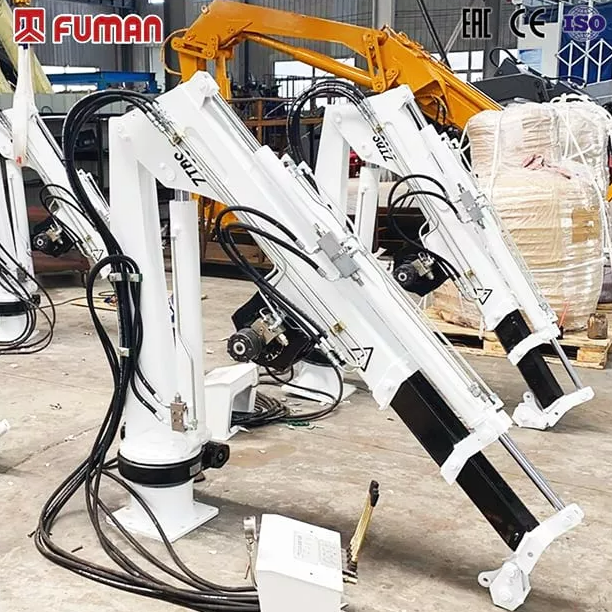
● Knuckle Boom Cranes: Known for their compact design and high maneuverability, they usually handle loads up to 70 tons. Their articulated arm allows precise placement in tight spaces.
● Folding Boom Cranes: A subtype of knuckle cranes, these can fold their booms for easy transport and storage, while still offering impressive lifting capacities, often up to 78,000 pounds (about 35 tons).
Load capacities vary based on crane size, design, and application. For example, marine cranes boom are engineered to lift heavy cargo or equipment on ships, often in the range of several tons to hundreds of tons, depending on vessel size and purpose. Timber cranes boom, used in forestry and construction, typically have capacities aligned with lifting logs or timber, which can range from a few tons to larger loads depending on the operation.
Applications in Construction and Manufacturing
Heavy lifting is a core function across many industries. In construction, boom cranes are essential for lifting steel beams, concrete panels, and large machinery. For example, lattice boom cranes may be used to erect high-rise buildings, lifting steel frameworks hundreds of feet into the air.
Manufacturing plants rely on boom cranes for moving heavy equipment, assembly parts, or large materials. Their ability to handle substantial loads quickly improves workflow and reduces downtime. Marine cranes boom are often used in shipbuilding and port operations, lifting cargo containers or heavy machinery onto vessels.
In forestry, timber cranes boom are designed to lift and transport logs efficiently. Their high load capacities and precise control help streamline logging operations, ensuring safety and productivity.
Key Considerations for Load Capacity
When selecting a boom crane, understanding load capacities is crucial. Factors influencing capacity include:
● Boom Length: Longer booms tend to reduce lifting capacity due to increased leverage.
● Lifting Radius: Capacity decreases as the load is moved farther from the crane's base.
● Counterweights: Proper counterweights are necessary to maintain stability during lifts.
● Structural Design: Reinforced materials and engineering determine maximum safe loads.
Operators must adhere to manufacturer specifications and safety guidelines to prevent overloading, which can cause accidents or equipment failure. Regular inspections and maintenance ensure cranes operate within safe limits, especially when handling heavy loads.
Efficiency and Time-Saving Benefits
Streamlining Project Timelines
Using boom cranes significantly accelerates project completion. Their impressive reach and lifting power allow for faster movement of heavy materials. Instead of relying on manual labor or multiple smaller machines, a single boom crane can handle large loads efficiently. For example, in high-rise construction, lattice boom cranes can lift steel beams hundreds of feet in the air, reducing the number of lifts needed and cutting overall project time. This speed not only shortens timelines but also minimizes disruptions on-site, keeping the project moving smoothly.
Furthermore, boom cranes can perform multiple tasks without needing to reposition frequently. Their adjustable booms and versatile configurations enable operators to switch between different lifts quickly. This adaptability means less downtime between tasks, leading to a more streamlined workflow. In shipping ports, marine cranes boom are used to load and unload containers swiftly, preventing delays in cargo handling and improving turnaround times for vessels.
Reducing Labor Costs
One of the biggest advantages of boom cranes is their ability to reduce labor expenses. Heavy lifting becomes safer and easier, requiring fewer workers to manually handle or guide loads. Instead of employing large teams for lifting operations, a trained operator can control the crane from a safe distance, minimizing the need for multiple personnel. This not only cuts costs but also enhances safety by decreasing the number of workers exposed to potential hazards.
In industrial manufacturing, boom cranes handle bulky equipment and materials, freeing up workers for other critical tasks. This division of labor leads to increased productivity overall. For example, timber cranes boom are used in forestry to lift logs efficiently, reducing the need for manual labor and speeding up processing times.
Additionally, modern boom cranes come equipped with advanced control systems, allowing operators to perform precise movements with minimal effort. This precision reduces errors and rework, further lowering labor costs linked to corrections or accidents caused by mishandling.
Connecting the Dots
By integrating boom cranes into your project, you leverage their ability to move heavy loads quickly and safely. This not only shortens project timelines but also cuts down on labor expenses. The result? Better resource allocation, increased productivity, and more competitive bids for construction, shipping, or manufacturing projects. Investing in the right boom crane tailored to your needs can deliver substantial long-term savings—making it a smart choice for any large-scale operation.
Versatility and Mobility of Boom Cranes
Different Configurations for Various Applications
Boom cranes are designed to adapt to a wide range of tasks. Their versatility stems from multiple configurations tailored to specific industries and environments. For example, some boom cranes are mounted on trucks, making them highly mobile and suitable for quick deployment across different job sites. These are often used in construction, shipping, and industrial maintenance. Others are fixed on stationary platforms, ideal for repetitive tasks like manufacturing or warehouse loading.
Different boom types also provide varied reach and lifting capacities. Telescopic booms extend to great lengths, perfect for high-rise construction or offshore platforms. Lattice booms, with their sturdy design, excel in heavy lifting, such as steel erection or large cargo handling. Knuckle and folding booms offer exceptional maneuverability, especially in tight or complex spaces.
Operators can choose from these configurations based on project needs. For instance, a construction site requiring high reach and variable load capacity might opt for a telescopic boom crane. Conversely, urban environments with limited space benefit from folding or knuckle boom cranes, which can fold compactly for transport and storage.
Adaptability in Diverse Environments
Boom cranes excel in diverse settings thanks to their adaptable features. They can operate efficiently in urban areas, industrial sites, ports, and even offshore environments. Their mobility allows quick relocation, minimizing downtime between tasks.
In urban construction, folding boom cranes are invaluable. Their compact design lets them navigate narrow streets, confined spaces, and indoor environments. For example, installing HVAC units on rooftops or lifting materials inside buildings becomes safer and faster with these cranes.
In marine or offshore settings, knuckle boom cranes are preferred for their space-saving design and stability. They can be mounted on ships or platforms, handling cargo, equipment, or personnel transfers even in rough seas. Their ability to fold reduces deck space usage, leaving room for other critical operations.
Port operations benefit from large lattice boom cranes, which can handle massive cargo containers swiftly. Their high reach and load capacity streamline loading and unloading, reducing vessel turnaround times.
Key Benefits of Mobility and Versatility
● Multiple configurations: Choose from telescopic, lattice, knuckle, or folding booms based on project demands.
● Mobility: Mounted on trucks or mobile platforms, they can quickly move across sites.
● Space efficiency: Folding and knuckle booms fold into compact sizes, ideal for tight spaces.
● Operational flexibility: Adjust boom angles, lengths, and attachments to suit varied tasks.
● Environment adaptability: Suitable for urban, industrial, marine, and offshore environments.
Practical Example
Imagine a construction project in a busy city. A folding boom crane can navigate narrow alleyways, lift HVAC units onto rooftops, and then fold for transport to the next site. Meanwhile, a lattice boom crane in a port handles large cargo containers, moving them swiftly from ships to trucks.
This adaptability reduces the need for multiple cranes, saves costs, and accelerates project timelines. It also enhances safety by allowing precise control in complex environments.
Safety Features and Precision Control
Advanced Control Systems
Boom cranes today come equipped with highly advanced control systems that enhance precision and safety during lifting operations. These systems often include hydraulic servo controls, which allow operators to make smooth, millimeter-level adjustments. This precision is crucial for delicate tasks, such as placing heavy loads in tight spaces or handling sensitive equipment.
Modern boom cranes, including marine cranes boom and timber cranes boom, often feature computerized control panels that provide real-time feedback on load weight, boom angle, and radius. These systems prevent overloading by automatically limiting lifting capacity based on current conditions, reducing the risk of accidents caused by operator error.
Remote control operation is another significant advancement. Operators can control the crane from a safe distance, improving visibility and reducing exposure to hazards. For example, knuckle boom cranes often come with wireless remote controls, allowing for more flexible and safer maneuvering, especially in confined or complex environments.
Safety Protocols and Training
Safety protocols are integral to operating boom cranes effectively. Operators must undergo thorough training to understand crane mechanics, load charts, and emergency procedures. Proper training ensures operators can respond quickly to unexpected situations, such as sudden load shifts or mechanical issues.
Regular inspections and maintenance are also vital. Safety devices like Load Moment Limiters (LML), overload protection, and hydraulic safety valves must be routinely checked to ensure they function correctly. These features help prevent structural damage and accidents by stopping unsafe lifts before they occur.
In industries like marine and forestry, where marine cranes boom and timber cranes boom operate in challenging conditions, adherence to safety protocols is even more critical. For instance, marine cranes must account for vessel movement and weather conditions, while timber cranes need to handle uneven terrain and heavy logs securely.
Employers should foster a safety culture that includes routine safety briefings, clear communication, and adherence to regulatory standards. This culture reduces risks and promotes efficient, accident-free operations.
Key Safety Features Summary
● Hydraulic servo controls for smooth, precise movements.
● Load Moment Limiters (LML) to prevent overload.
● Real-time monitoring of load weight and boom position.
● Remote control operation for enhanced operator safety.
● Regular training and certification for operators.
● Routine maintenance and inspection of safety devices.
Practical Example
Consider a marine crane boom used on a cargo ship. Its advanced control system allows the operator to precisely position heavy containers despite ship movement caused by waves. Load Moment Limiters prevent overloading, while remote controls enable the operator to maintain a safe distance from the load. Such safety features protect personnel and cargo, ensuring smooth port operations.
Cost-Effectiveness of Boom Cranes
Long-term Savings and ROI
Investing in a boom crane can lead to significant long-term financial benefits. While the initial purchase or rental cost might seem high, the savings over the machine's lifespan are substantial. Boom cranes increase productivity by handling heavy loads quickly and efficiently, reducing the time needed for each project phase. For example, a well-chosen crane can lift and move materials that would take multiple workers days to do manually or with smaller equipment. This acceleration in workflow means projects finish faster, leading to earlier revenue generation and less overhead.
Moreover, boom cranes are durable and built to last, especially when maintained properly. High-quality models, such as marine cranes boom or timber cranes boom, are designed to withstand harsh environments, reducing repair costs and downtime. Over time, these factors contribute to a high return on investment (ROI). Companies that regularly utilize boom cranes often see a decrease in labor costs, fewer delays, and increased project throughput.
Impact on Project Budgets
Boom cranes can dramatically influence overall project budgets. They help control costs by minimizing the need for multiple smaller machines or extensive manual labor. For example, in construction, a single boom crane can replace several smaller cranes or a large team of workers, saving on equipment rental fees and wages.
Additionally, their efficiency reduces project duration, which cuts indirect costs such as site management, security, and equipment storage. In shipping ports, marine cranes boom streamline cargo handling, enabling ships to dock and unload faster. This quick turnaround saves port operators money through reduced docking fees and increased vessel traffic capacity.
Another budget advantage comes from the versatility of boom cranes. Different configurations—such as telescopic, lattice, or knuckle booms—allow operators to select the best tool for each job. This adaptability prevents the need to rent or buy multiple specialized machines, further lowering costs.
Examples of Cost Savings
● Reduced labor costs: Fewer workers needed for heavy lifting tasks.
● Faster project completion: Shortening timelines minimizes overhead expenses.
● Lower equipment rental fees: One versatile crane replaces multiple machines.
● Decreased downtime: Durable, well-maintained cranes stay operational longer.
● Enhanced safety: Fewer accidents mean less insurance and liability costs.
Final Thoughts
Choosing the right boom crane can be a strategic decision that pays off over time. By investing in quality equipment suited to your specific needs, you ensure faster project delivery, lower operational expenses, and higher overall profitability. For businesses aiming to maximize their ROI, understanding these long-term savings is crucial when planning equipment purchases or rentals.
Specialized Uses of Knuckle and Folding Boom Cranes
Benefits in Tight and Confined Spaces
Folding boom cranes, also known as knuckle boom cranes, shine in tight and confined spaces. Their compact design allows them to operate where traditional cranes can't fit. This makes them ideal for urban construction sites, indoor projects, or anywhere space is limited. Their ability to fold the boom reduces their overall size, making transportation and setup quick and simple. This means less disruption on busy job sites and faster project completion.
The key advantage is their maneuverability. Operators can extend, retract, and articulate the boom to reach over obstacles or into narrow areas. For example, installing HVAC units on rooftops or lifting heavy materials inside buildings becomes safer and more efficient. The crane's flexibility allows it to perform lifts at various angles, even in crowded environments with overhead wires, existing structures, or uneven terrain.
Another benefit involves safety. In tight spaces, precision control minimizes the risk of accidents. Operators can position loads accurately, avoiding damage to property or injury to workers. The folding feature also helps in storage, especially on ships or in industrial yards, freeing up valuable space when the crane isn't in use.
Applications in Urban and Industrial Projects
Urban construction demands cranes that are both powerful and adaptable. Folding boom cranes fit perfectly here. They can navigate narrow streets, alleyways, or indoor environments where larger cranes would struggle. For example, placing heavy HVAC units on rooftops or installing structural components inside tight building interiors becomes more manageable.
In industrial settings, these cranes support tasks like warehouse loading, factory assembly, or maintenance work. Their quick setup and mobility mean they can be repositioned easily, reducing downtime. Their ability to fold also makes them suitable for indoor use, where space is at a premium and safety is critical.
Marine and offshore projects also benefit from folding boom cranes. Their compact size allows them to operate on ships or platforms with limited deck space. They can handle cargo, equipment, or personnel transfers efficiently, even in challenging conditions. Their flexibility helps in reaching around obstacles or working in confined areas on vessels.
Practical Examples
Imagine a construction site in a busy city. A folding boom crane can navigate narrow streets, lift heavy materials onto rooftops, then fold down for transport to the next location. Meanwhile, in a port, a lattice boom crane handles large containers swiftly, but a folding boom crane is used inside warehouses or on ships where space is tight.
Another example: in an indoor factory, a folding boom crane can lift bulky machinery or materials without needing extra clearance. Its mobility and compactness reduce setup time and allow quick repositioning, helping projects stay on schedule.
Conclusion
Boom cranes offer significant benefits, including heavy lifting capabilities, efficiency, and versatility. They streamline project timelines and reduce labor costs, making them invaluable in construction, manufacturing, and marine industries. Their adaptability in diverse environments and advanced safety features enhance operational efficiency. Investing in the right boom crane provides long-term savings and improved productivity. For those seeking reliable solutions, FUMAN offers products tailored to meet these needs, ensuring safety and efficiency in every application.
FAQ
Q: What are the main uses of marine cranes boom?
A: Marine cranes boom are primarily used in shipbuilding and port operations for lifting heavy cargo or machinery onto vessels, enhancing efficiency and reducing turnaround times.
Q: Why are timber cranes boom preferred in forestry?
A: Timber cranes boom are favored in forestry due to their high load capacities and precision control, which streamline logging operations and improve safety and productivity.
Q: How do boom cranes reduce labor costs?
A: Boom cranes reduce labor costs by performing heavy lifting with fewer workers, minimizing manual handling, and enhancing safety through advanced control systems.


