


Choosing Truck Mounted Crane Boom Length for Jobsites
Views: 0 Author: Site Editor Publish Time: 2026-09-15 Origin: Site


As a field engineer who has spent years navigating muddy construction sites and congested industrial yards, I have seen it happen far too often. A project manager orders equipment based on a quick visual estimate, only to realize upon arrival that the machine cannot safely reach the designated drop zone. This single miscalculation forces work stoppages, demands expensive secondary rentals, and completely derails project timelines.
The backbone of any mobile lifting operation is the truck mounted crane boom. Its length dictates much more than just how high you can hoist a load. It fundamentally determines your working radius, maximum safe load capacity, and overall versatility. Choosing the correct specification prevents catastrophic safety hazards and stops you from bleeding your budget on an oversized, fuel-hungry machine that cannot maneuver through your site.
In this guide, we will break down the empirical framework for calculating and selecting the exact boom length you need. We will also dive deep into heavy-duty logistical tasks, specifically focusing on the rigorous demands of container handling.
Key Takeaways for Field Operations
Capacity vs. Reach: Boom length and lifting capacity share a brutal inverse relationship. As you extend the boom, leverage physics dictate that your maximum safe load weight drops exponentially.
Site Geometry: Urban, highly congested jobsites require entirely different boom profiles and articulation capabilities than open commercial ports.
Container Handling: Moving static, massive loads requires specialized equipment with U-shaped cross-sections to ensure structural rigidity and prevent lateral sway.
The Load Chart is Absolute: Never finalize a boom length without mapping your heaviest potential load against the manufacturer's official chart at your maximum required working radius.
Industry Shift: Why Boom Optimization is the New Standard
Before diving into the physics, it is crucial to understand where the lifting industry is heading. Recent market data shows a distinct shift driven by urban densification and stricter commercial vehicle weight regulations. Contractors are rapidly moving away from traditional, heavy-footprint lattice booms. Instead, the trend heavily favors ultra-high-tensile steel telescopic booms. Modern metallurgical advancements—like the use of HG785 steel—allow manufacturers to engineer thinner, lighter boom sections. This evolution gives operators a 100-foot-plus reach without requiring a massive Class 8 truck chassis, perfectly balancing maneuverability with extreme lifting height.
Why Your Boom Length is a Make-or-Break Decision
The foundational physics of mobile lifting dictate that the boom acts as a giant lever. The crane's center of rotation serves as the fulcrum, while your suspended cargo acts as the downward force. Consequently, selecting your boom length is not just about touching a specific elevation. It is about maintaining vehicle stability under immense mechanical stress.
The Triangle of Lifting: Reach, Height, and Capacity
Every lift is governed by a strict geometric relationship between horizontal reach, vertical height, and weight capacity—often referred to by engineers as the "Triangle of Lifting." When you extend a boom to clear a rooftop, you inherently push the horizontal distance further from the crane's center of gravity.
Physics is unforgiving here. A longer boom severely reduces the maximum weight you can safely hold at the tip. For instance, a crane rated for 20 tons at a 10-foot radius might see its capacity plummet to a mere 4 tons when extended to a 40-foot radius. Grasping this inverse relationship is the first step in safe equipment procurement.
The Financial Bleed of Guesswork
Failing to calculate your required boom length carries massive operational risks. An undersized boom means the job simply cannot be done. You are forced to halt operations, send the truck back, and source alternative machinery. In contrast, overcompensating with an oversized boom leads to wasted upfront capital. Furthermore, longer booms possess heavier deadweights, requiring larger commercial chassis. This spikes your daily fuel consumption and destroys your ability to set up in tight urban alleys.
4 Critical Metrics for Sizing Your Boom
To make an evidence-based purchasing decision, you must evaluate four primary metrics. In heavy machinery, guesswork gets people hurt.
1. Maximum Lifting Height (Vertical Reach)
Vertical reach is the absolute highest point your load needs to access. However, calculating this requires factoring in jobsite realities. You must account for the physical dimensions of the load itself, the length of your rigging (wire rope slings, spreader bars), the height of the hook block, and a mandatory anti-two-block safety clearance margin—typically 3 to 5 feet.
2. Working Radius (Horizontal Reach)
Working radius is the horizontal distance from the crane's center of rotation to the load's center of gravity. In real-world applications, horizontal reach dictates your boom length far more often than vertical height. If your truck cannot park directly adjacent to the foundation due to muddy trenches or unstable soil, your working radius increases dramatically. You need a longer boom just to bridge that standoff distance.
3. Mastering the Crane Load Chart
The manufacturer's load chart is the definitive law of the jobsite. It cross-references boom length and working radius to dictate your maximum safe capacity. Notice how capacity drops as you move further to the right and down the chart. This reduction accounts for both the leverage of the cargo and the increased dead weight of the extended steel sections.
4. Jobsite Spatial Constraints
Physical limitations dictate what you can actually deploy. Overhead obstacles, like active power lines, restrict your maximum boom angle. Ground-level constraints, such as allowable outrigger spread and local soil bearing capacity, determine exactly how large of a chassis you can safely stabilize without risking a rollover.
Specialized Solutions: Handling Massive Logistical Loads
Logistics yards and heavy material transport sectors present unique lifting challenges. Moving standardized ISO shipping containers requires extreme precision. A fully loaded 40-foot container can weigh upwards of 67,200 lbs. Lifting these static, asymmetrical loads demands high capacity at short radii and absolute minimal lateral sway.
Choosing the Right Equipment for Container Handling
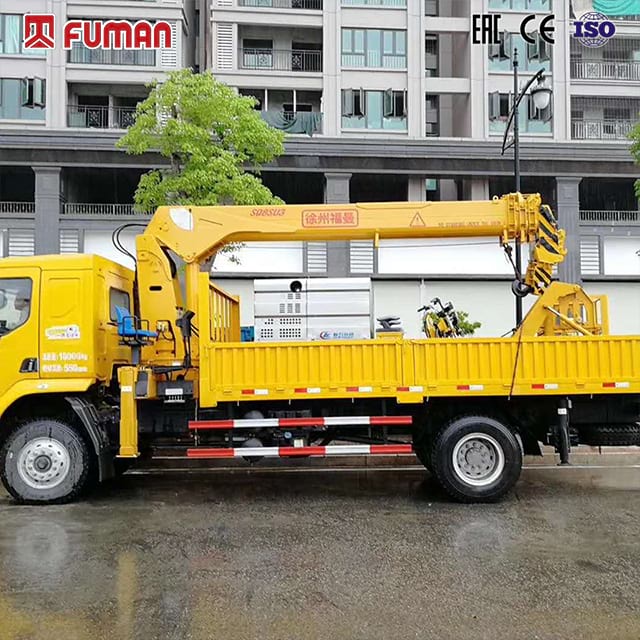
For stacking and maneuvering shipping containers, structural rigidity is non-negotiable. A dedicated Truck-mounted crane arm for container lifting provides the optimal solution. Telescopic booms utilize smooth, synchronized linear extension powered by heavy-duty hydraulic cylinders.
Unlike knuckle booms, which have multiple hinge points that can introduce dangerous sway, a stiff telescopic boom maintains strict alignment. For instance, advanced models utilize U-shaped cross-sections that distribute stress evenly, ensuring the container remains perfectly level. When dealing with diverse intermodal yards, investing in a Telescopic truck-mounted crane arm for container handling ensures your fleet can adapt to varying payload sizes without compromising structural stability.
Precision Micro-Adjustments
Container loading is rarely a simple vertical drop. It requires micro-adjustments to align heavy corner castings with flatbed trailer twist-locks. Specifically, a Hydraulic truck crane arm for container loading offers superior proportional control. High-end hydraulic proportional valve banks allow operators to make millimeter-precise movements, lowering heavy containers gently to prevent structural damage to the chassis below.
Matching Boom Type to Your Specific Jobsite
Matching your boom profile to the environment is critical for operational flow. Here is a breakdown of how different sites dictate your equipment selection.
Jobsite Environment | Recommended Boom Type | Key Engineering Priority |
|---|---|---|
Urban & Congested Alleys | Compact Telescopic / Articulating | Minimal outrigger footprint, tight turning radius. |
Highway & Utility Maintenance | Long-Reach Straight Boom | Shoulder standoff distance, rapid deployment. |
Industrial Logistics Yards | Heavy-Duty Stiff Boom (U-Shape) | High duty-cycle durability, lateral sway reduction. |
The Needs Assessment Framework: Calculating Ideal Length
Selecting equipment requires a systematic mathematical approach. You must rely on empirical data and jobsite geometry to determine your precise specifications.
The "Rule of Thumb" Formula
The fundamental calculation relies on the Pythagorean theorem. The boom acts as the hypotenuse of a right-angled triangle. The horizontal distance to the load forms the base, while the vertical lifting height forms the vertical side.
To estimate your minimum boom length, square the horizontal radius, square the vertical height, add them together, and calculate the square root. However, this raw calculation only provides the theoretical minimum. In practical applications, you must add a 10% to 15% safety margin to account for boom deflection under load and rigging clearance.
Factoring in Jibs for Extended Reach
Procuring a crane with a massive main boom isn't always practical. For projects that occasionally require extra reach, utilizing swing-away jibs is highly efficient. This allows you to maintain a compact travel footprint for daily tasks while bolting on extra reach when necessary. Just remember, deploying a jib drastically alters your structural capacity, and you must strictly follow the dedicated jib load chart.
Common Mistakes to Avoid in the Field
Even seasoned procurement teams make critical errors when analyzing specifications. If you have ever heard a Load Moment Indicator (LMI) alarm blare unexpectedly, it is usually due to one of the following oversights.
Ignoring the "Derating" Effect
A pervasive misconception is that a crane's maximum capacity applies everywhere. In reality, as the boom extends, the center of gravity shifts. This results in a severe "derating" effect. Relying on the crane's nominal maximum capacity—instead of calculating the exact weight at your specific required radius—is the leading cause of tipping accidents.
Forgetting the Weight of the Rigging
Operators frequently weigh the object being lifted and stop there. Standard engineering protocols dictate that *everything* suspended from the boom tip must be factored into the gross load. This includes the hook block, wire ropes, synthetic slings, and heavy steel spreader bars. When lifting shipping containers, specialized spreader frames can weigh thousands of pounds on their own.
Maximizing Efficiency and Longevity
Proper selection is only phase one. Once deployed, rigorous operational habits protect your capital investment.
Best Practices for Setup
Efficiency begins with truck positioning. Your primary objective is to park the crane's center of rotation as close to the load as safely possible. Minimizing the horizontal radius allows you to keep the boom retracted, maximizing structural stability. Furthermore, operators must strictly avoid side-loading the boom—dragging loads laterally will cause permanent twisting of the telescopic sections.
Maintenance for Long Booms
Multi-stage booms require meticulous upkeep. The internal mechanisms, including hydraulic extension cylinders and synthetic wear pads, face extreme friction. Wear pads must be inspected monthly for proper thickness to prevent metal-to-metal gouging. Regular lubrication with manufacturer-approved grease is non-negotiable for smooth telescopic action.
Conclusion
Choosing the right truck mounted crane boom length requires careful mathematical assessment and a deep understanding of your jobsite environments. You must accurately gauge your maximum gross load, your working radius, and the spatial limitations you face daily. The correct equipment saves countless man-hours and prevents devastating accidents.
Always review load charts meticulously, factor in your rigging weight, and map out your site constraints. If you need robust, engineering-grade equipment designed to handle the harshest logistical environments, explore advanced solutions like the F300TC-04. For a comprehensive consultation to match your exact payload requirements, visit Fuman Crane to secure the perfect lifting asset for your fleet.
FAQ
How tall is a standard boom truck?
Standard truck-mounted cranes vary significantly depending on their engineering class. Typically, main boom lengths range from 30 feet for light-duty residential work to over 150 feet for commercial construction. When auxiliary attachments like swing-away jibs are deployed, total vertical reach can exceed 200 feet. Maximum height is achieved at a near-vertical boom angle, which simultaneously reduces your horizontal working radius to its absolute minimum.
Can I add an extension to my current truck mounted crane boom?
Yes, modifying the reach is possible if the manufacturer has engineered the boom head to accept attachments. Many telescopic booms support the integration of swing-away jibs or manual pull-out sections. However, adding an extension alters the fundamental physics of the machine. The additional deadweight at the tip reduces the overall main boom lifting capacity, requiring strict adherence to a separate jib load chart.
What is the best truck-mounted crane arm for container lifting?
Container lifting involves handling large, static loads with asymmetric weight distribution. A heavy-duty, multi-stage telescopic stiff boom is the most effective solution. Telescopic booms provide the high structural rigidity required to minimize load sway when lifting 20-foot or 40-foot containers, offering superior capacity at close-to-medium ranges compared to articulating knuckle booms.
How do I read a boom crane load chart?
A load chart is a grid cross-referencing your operational variables. First, locate your required working radius (horizontal distance from the center pin to the load) on the top or bottom axis. Next, locate your required boom length on the vertical axis. Follow the row and column to their intersection. That number is the maximum safe gross capacity. You must then subtract the weight of all rigging equipment to find your actual allowable cargo weight.
At what wind speed should I retract a fully extended crane boom?
Wind acts as a massive lateral force on both the suspended load and the boom surface area itself. While specific limits depend on the manufacturer's engineering guidelines, industry standards generally dictate halting operations and retracting the boom when sustained wind speeds exceed 20 to 25 mph (32 to 40 km/h). Always consult your crane's specific operator manual, as handling large surface-area loads like shipping containers requires even lower wind thresholds.
Does boom deflection affect my maximum lifting height?
Yes, significantly. Boom deflection is the natural, engineered bending of the steel boom sections under heavy load. When lifting near maximum capacity, the boom will physically bow downward. This deflection increases your working radius slightly and decreases your actual vertical hook height. Experienced operators always calculate an extra margin of clearance to account for this physical bending during the lift.


