


How Does a Truck Mounted Crane Boom Work?
Views: 0 Author: Site Editor Publish Time: 2026-09-01 Origin: Site


Time is money on modern construction sites. Do you have the right lifting equipment to keep your projects on schedule? Many operators know how to drive a commercial vehicle. However, few truly understand the underlying physics and fluid dynamics that make these powerful machines function.
In this comprehensive technical guide, we break down exactly how these hydraulic systems operate. By understanding the core mechanics, you can manage lifts safely and prevent catastrophic equipment failures. Furthermore, this knowledge will empower you to make highly informed, cost-effective purchasing decisions for your fleet.
Key Takeaways
Hydraulic Power is Key: Mobile lifting equipment relies on highly pressurized fluid to generate the immense force required for heavy hoisting.
Anatomy Matters: Safe operation requires perfect synergy between outriggers, hydraulic cylinders, and the winch system.
Telescopic vs. Knuckle: Boom configuration choices depend entirely on job site space, payload needs, and overhead clearance.
Safety & Compliance: Strict adherence to load charts and LMI (Load Moment Indicator) data prevents tip-overs.
Smart Purchasing: Selecting machinery demands a deep analysis of load radius, chassis GVWR compatibility, and long-term maintenance.
Understanding the Basics: What is a Truck Mounted Boom?
To make informed decisions about heavy machinery, establishing clear definitions is paramount. A Truck-mounted crane boom for material lifting is essentially a hydraulic apparatus integrated directly onto a heavy-duty commercial vehicle chassis. This ingenious configuration allows the vehicle to travel at standard highway speeds. It eliminates the need for expensive flatbed transport. More importantly, it retains the ability to hoist heavy construction materials immediately upon arrival at a job site.
Concept Clarification: Truck Crane vs. Boom Truck
In the heavy equipment industry, terminology can sometimes overlap. This often leads to confusion during the procurement process. However, a distinct technical difference exists.
A "Truck Crane" typically refers to a purpose-built, custom chassis designed exclusively for lifting. The driving cab and the operating cab are often entirely separate. These machines are engineered for extremely heavy, specialized lifts. Conversely, a "Boom Truck" utilizes a standard commercial truck chassis with a crane unit mounted on the rear or directly behind the driving cab.
Despite these technical differences, the primary value proposition remains consistent: unparalleled mobility. Unlike crawler cranes that require days to assemble, this equipment can drive onto a site, deploy its outriggers, and begin operations within minutes.
The Core Mechanics: Fluid Dynamics in Action
The operation of a crane is not magic. It is a precise application of fluid dynamics and classical physics. Understanding these mechanics is essential for operators feathering the controls and fleet managers calculating maintenance intervals.
The Magic of Hydraulics (Pascal’s Law)
Imagine standing next to the vehicle as the operator prepares for a lift. They engage a switch in the cab, and a low, steady hum resonates from beneath the chassis. This is the Power Take-Off (PTO) springing to life. The PTO is a mechanical gearbox attached to the transmission. It diverts rotational power from the truck's engine to a robust hydraulic pump.
This pump moves specialized hydraulic oil throughout the crane's circulatory system. According to Pascal’s Law, pressure applied to a confined fluid is transmitted undiminished in every direction. When the pump forces this incompressible fluid into the cylinders at extreme pressures—often exceeding 3,000 PSI—it creates a massive pushing or pulling force. Consequently, a relatively small steel cylinder can effortlessly lift tons of concrete.
Leverage and the Center of Gravity
A crane operates on the fundamental principles of leverage. The boom acts as a giant lever. The turret base serves as the fulcrum. Meanwhile, the hydraulic cylinders provide the effort required to lift the payload.
Hoisting heavy materials dramatically shifts the vehicle's center of gravity. This introduces the critical concept of the "load moment." The load moment is calculated by multiplying the load's weight by the horizontal distance from the crane's center of rotation (the radius). As the boom extends further out, the radius increases. This drastically amplifies the load moment. If this force exceeds the structural capacity or the truck's stabilizing counter-moment, the equipment will inevitably tip over.
Anatomy of a Hydraulic Crane Boom
To fully grasp how the machine functions, one must examine its individual components. Every part of a Hydraulic truck-mounted crane boom for lifting materials is engineered with specific safety factors and strict material tolerances.
The Boom Assembly
The boom is the most visible and heavily stressed part of the crane. These nested sections must withstand extreme bending moments and twisting forces. Therefore, they are manufactured from ultra-high-yield-strength structural steel, such as HG785. The geometric shape of the boom—often hexagonal or U-shaped—is specifically engineered to prevent buckling under heavy compression.
Hydraulic Cylinders and Pumps
The muscle of the crane is divided into highly specific hydraulic tasks. Lift cylinders are massive, thick-barreled components attached to the boom base. When flooded with pressurized fluid, they raise the angle of the entire assembly. Extension cylinders are housed safely inside the boom sections, pushing the telescoping segments outward. Finally, a specialized slewing motor allows the turret to rotate continuously, offering a full 360 degrees of motion.
The Winch and Outriggers
While the boom provides height and reach, the winch handles the vertical hoisting. It utilizes high-tensile steel wire rope wound tightly around a grooved spool. Modern systems include an anti-two-block (A2B) device, a critical safety mechanism that prevents the hook block from snapping the wire rope.
Furthermore, a standard truck suspension cannot anchor a heavy lift. Outriggers are hydraulically extending legs that deploy outward and downward. They bypass the truck's soft suspension, lifting the tires slightly off the ground. This dramatically widens the footprint of the vehicle, creating a rigid, stable platform.
Telescopic vs. Knuckle: Choosing the Right Configuration
When configuring a fleet, decision-makers must choose between two primary boom designs. Each possesses distinct engineering advantages based on the intended daily application.
Telescopic Boom Cranes
A Telescopic truck crane boom for material handling features straight, nested sections that extend linearly. This design offers exceptional vertical and horizontal reach.
It is the ideal choice for lifting materials to high elevations, such as placing heavy HVAC units on commercial roofs. The operation relies heavily on the winch for hoisting. However, telescopic booms require significant overhead clearance to operate safely. They are noticeably less versatile in tight, low-clearance indoor environments.
Knuckle Boom (Articulating Boom) Cranes
In contrast, a knuckle boom operates similarly to a human finger, featuring multiple hinged joints. These cranes are highly flexible and navigate complex obstacles with pinpoint precision.
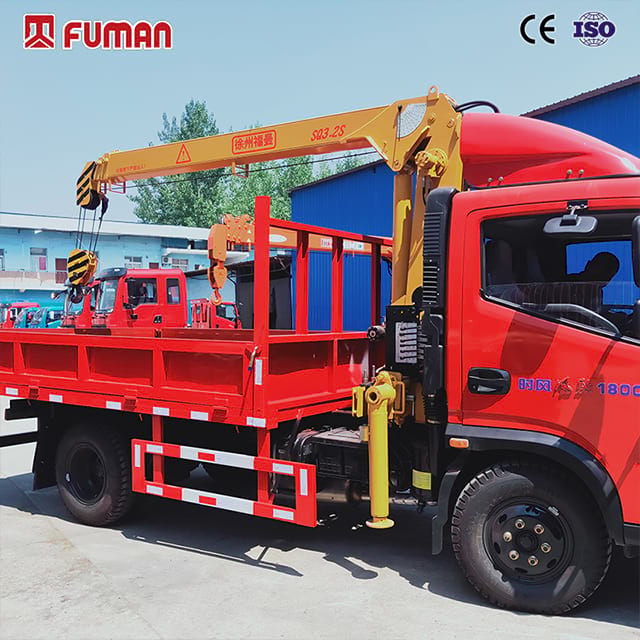
For example, integrating a 3.2 Ton Truck Mounted Knuckle Boom Crane onto a transport vehicle creates a self-sustaining delivery system. It provides a robust 3.2-ton lifting capacity while folding up compactly behind the cab. This leaves the majority of the truck bed wide open for transporting payload. The trade-off is a generally shorter maximum reach compared to telescopic models.
Side-by-Side Comparison
Technical Feature | Telescopic (Straight) Boom | Knuckle (Articulating) Boom |
|---|---|---|
Primary Motion | Linear extension via internal cylinders | Articulating via multiple hinged joints |
Maximum Reach | Exceptional (Ideal for high elevations) | Moderate (Optimized for close-quarters) |
Clearance Needs | Requires unobstructed overhead space | Excels in low-clearance environments |
Chassis Footprint | Consumes significant bed space | Folds compactly, maximizing cargo area |
Ideal Application | Roofing, telecommunications, structural steel | Logistics, heavy cargo delivery, municipal work |
Top Industry Applications for Material Lifting
The versatility of mobile lifting equipment allows it to be deployed across a wide spectrum of industries. The ability to drive directly to a site, execute a complex lift, and relocate within the same afternoon provides unmatched operational efficiency.
In the construction sector, time is a critical factor. Boom trucks hoist structural components directly to their final installation points. Tasks include lifting wooden roof trusses, positioning cinder blocks, and moving pallets of shingles. By extending the boom over obstacles, contractors significantly reduce manual labor, accelerating project timelines.
Similarly, the utility sector relies heavily on these machines for infrastructure maintenance. They are the standard equipment for setting utility poles and positioning heavy electrical transformers. Operators must navigate around live power lines, requiring absolute precision and smooth hydraulic feedback.
Essential Safety Standards and Operational Best Practices
Operating heavy hydraulic machinery involves inherent risks. A momentary miscalculation regarding load weight or ground stability can lead to structural damage. Adhering to strict safety protocols is non-negotiable.
Mastering the Load Chart
The single most important document for any operator is the manufacturer’s load chart. A common misconception is that a "10-ton crane" can lift 10 tons under any circumstance. In reality, maximum capacity is only achievable when the boom is fully retracted and positioned at a steep angle.
As the boom extends outward, the leverage exerted by the load increases. Consequently, actual lifting capacity decreases. Modern trucks are equipped with a Load Moment Indicator (LMI) system. This computerized safety device tracks metrics in real-time and automatically locks out hydraulic functions if a lift exceeds safe structural limits.
Site and Environmental Considerations
Environmental factors dictate crane stability. Before deploying outriggers, operators must assess ground conditions. Soft soil can cause an outrigger to punch through the earth, leading to an immediate tip-over. Specialized outrigger pads must be used to distribute the point load over a larger surface area.
Furthermore, weather introduces dynamic loads. High winds catch bulky loads, acting like a massive sail. This lateral side-loading introduces stress that booms are not designed to withstand. Lifting operations must be suspended if sustained wind speeds exceed safety thresholds.
Industry Trends: The Evolution of Mobile Lifting Technology
Recent market analyses reveal a significant shift in mobile crane engineering. As urban environments enforce stricter noise and emission regulations, the industry is rapidly adopting hybrid and fully electric PTO (ePTO) systems. These innovations allow hydraulic pumps to operate silently and emission-free on job sites, without idling the main diesel engine.
In addition, manufacturers are increasingly utilizing advanced lightweight alloys and ultra-high-strength steel. This reduces the dead weight of the lifting apparatus, directly increasing the allowable payload capacity on the truck chassis. The integration of IoT (Internet of Things) sensors is also revolutionizing fleet management. Modern equipment now transmits real-time data on hydraulic pressure fluctuations and structural stress directly to cloud dashboards, enabling predictive maintenance.
Buying Guide: How to Choose the Right Equipment
Purchasing mobile lifting equipment represents a significant capital expenditure. Making an informed decision requires moving beyond basic capacity numbers. You must conduct a thorough analysis of your specific operational needs.
Assess Your Maximum Load and Radius: The most common mistake is purchasing based solely on the heaviest anticipated load. If you need to lift a 5,000-pound unit 40 feet away from the truck, a standard 5-ton crane will fail. The capacity at that specific radius might drop to 2,000 pounds. Calculate your absolute maximum required lift at your maximum required radius, then add a 20% safety buffer.
Evaluate Chassis Compatibility: A crane is only as stable as its foundation. Buyers must evaluate the Gross Vehicle Weight Rating (GVWR), axle weight ratings, and the Section Modulus (frame strength) of the truck. If the chassis frame is too weak, the torque generated during a lift will permanently deform the vehicle.
Conclusion
Understanding exactly how a truck-mounted boom works—from the hum of its PTO pump to the limits of its telescoping sections—is the first step in profitable material handling. By respecting the physics of leverage and adhering to load charts, operators can perform complex lifts with absolute confidence.
Ultimately, choosing between a telescopic or knuckle configuration comes down to your specific job site requirements, overhead clearances, and payload needs. Equip your team with the right knowledge, and your machinery will deliver years of reliable service.
Ready to upgrade your fleet's capabilities? Explore Fuman Crane's extensive inventory to find your ideal lifting solution. Reach out for a professional engineering consultation today, and request a detailed quote tailored to your specific project needs.
FAQ
How much weight can a truck mounted crane boom lift?
Capacities range widely depending on the engineering of the specific unit. They start from small 2-ton models designed for light municipal work to massive 40+ ton units used in heavy construction. However, actual lifting capacity at any given moment is not a static number. It depends entirely on the boom's current extension length and angle. As the load moves further away from the truck's center of gravity, lifting capacity drops significantly.
How far can a telescopic truck crane boom extend?
Standard commercial models typically offer main boom lengths ranging between 30 to 100 feet. This is sufficient for most mid-rise construction applications. For specialized high-reach requirements, high-capacity units can extend upwards of 150 feet. This extended reach is often achieved by attaching manual or hydraulic jib extensions to the tip of the main boom.
What is the difference between a load chart and a Load Moment Indicator (LMI)?
A load chart is a physical, printed grid provided by the manufacturer that dictates the maximum safe lifting capacity at various boom angles and extension lengths. An LMI is an onboard computerized safety system. The LMI uses sensors to read the actual weight on the hook, the boom angle, and the radius in real-time. It compares this live data against the load chart and will automatically halt hydraulic functions if the operator attempts a lift outside safe parameters.
How does wind speed affect mobile crane operations?
Wind introduces dangerous lateral forces, known as side-loading, to the crane structure. Booms are engineered to handle immense vertical compression, but they are highly vulnerable to sideways stress. Strong winds can catch a large load and swing it outward, instantly increasing the load radius and causing the crane to tip over. Operations must strictly halt when wind speeds exceed the manufacturer's specified limits (often around 20-30 mph, depending on the load's surface area).
What is the lifespan of this hydraulic equipment?
The structural and operational lifespan is directly tied to the rigor of your preventative maintenance program. With strict adherence to scheduled maintenance—including regular lubrication of wear pads, routine hydraulic fluid changes, and diligent wire rope inspections—a high-quality unit can remain operational for 15 to 25 years. In many cases, a well-maintained lifting apparatus will outlast the original commercial truck chassis it was mounted on.


